Single-Screw Extrusion of Polymer Composites
Modeling pellet motion, melting, deformation, and fiber length attrition to capture the solid–melt transition and its effect on extrudate quality. Ph.D. thesis work.
Overview
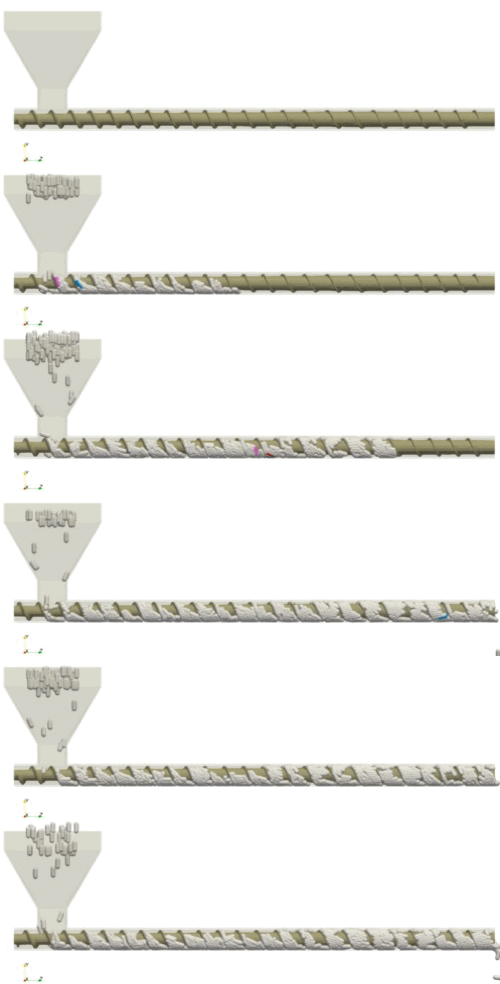
Developed a unified DEM–FEM–analytical modeling framework during my Ph.D. to predict pellet motion, melting, deformation, and fiber breakage for long-discontinuous fiber-reinforced polymer pellets. This work appears in my thesis and related publications (Kapre, 2024), (Kapre et al., 2025), (Kapre et al., 2024).

Approach
- DEM (LIGGGHTS) for pellet motion and kinematics
- FEM (ABAQUS) for heat transfer and melting of individual pellets
- Beam theory + Weibull model for pellet deformation and fiber breakage
- Coupled these into a melt progression + fiber-length evolution framework

Key Results
- Pellets recirculate primarily in the second half of the screw, aligning with rapid outside–in melting
- Fiber breakage initiates once the outer pellet layer melts
- Starve-feeding reduces residence time and fiber attrition; high RPM can cause incomplete melting
- Predicted bimodal fiber-length distributions match experiments
Impact
Provides a quantitative basis to tune screw geometry, feeding mode, and processing conditions to preserve fiber length and improve composite performance; extensible to other thermoplastic and extrusion-based AM feedstocks.
Tools
LIGGGHTS, ABAQUS, MATLAB, Python, HPC environment; Material: 40% CF-PPS
References
2025

2024
-
 Fiber Length Attrition of Long-Discontinuous Fiber Reinforced Polymer Pellets in a Single Screw ExtruderPurdue University, 2024
 -
 Modeling Flow of Long Discontinuous Fiber Reinforced Polymer Pellets in a Single Screw ExtruderIn Proceedings of the ASME Aerospace Structures, Structural Dynamics, and Materials Conference, 2024